


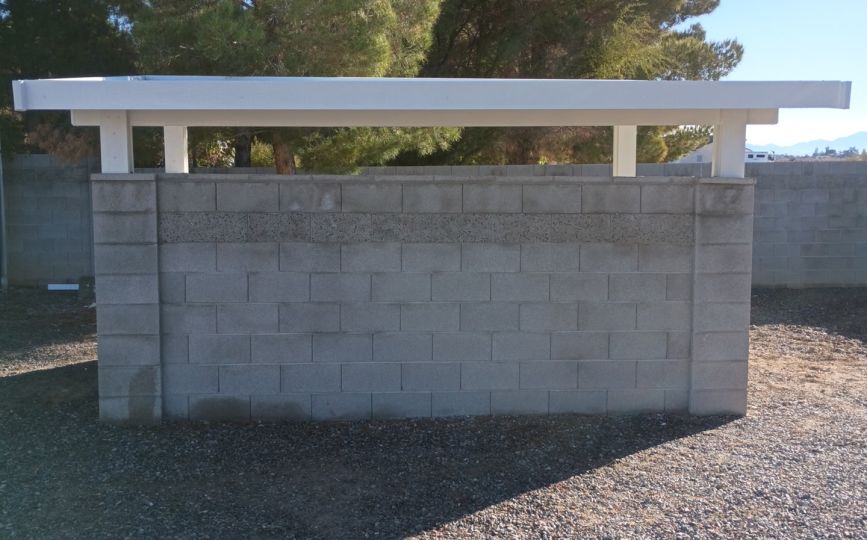
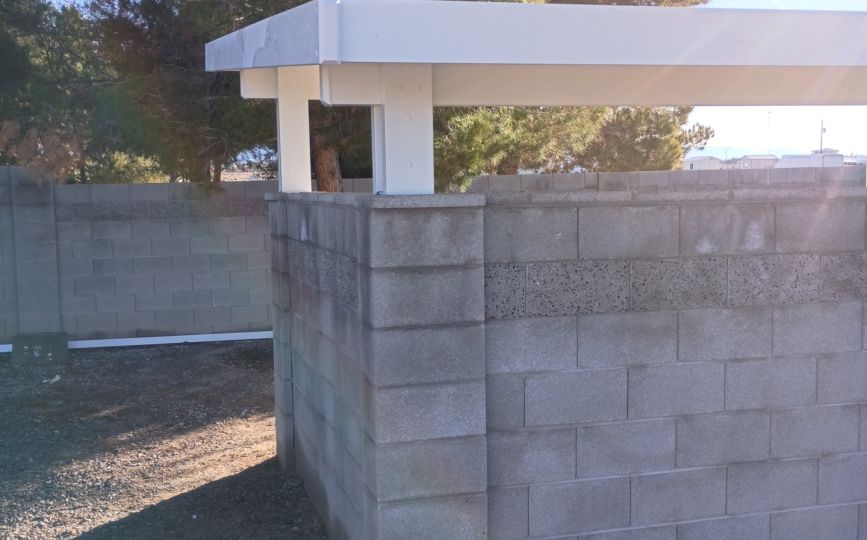
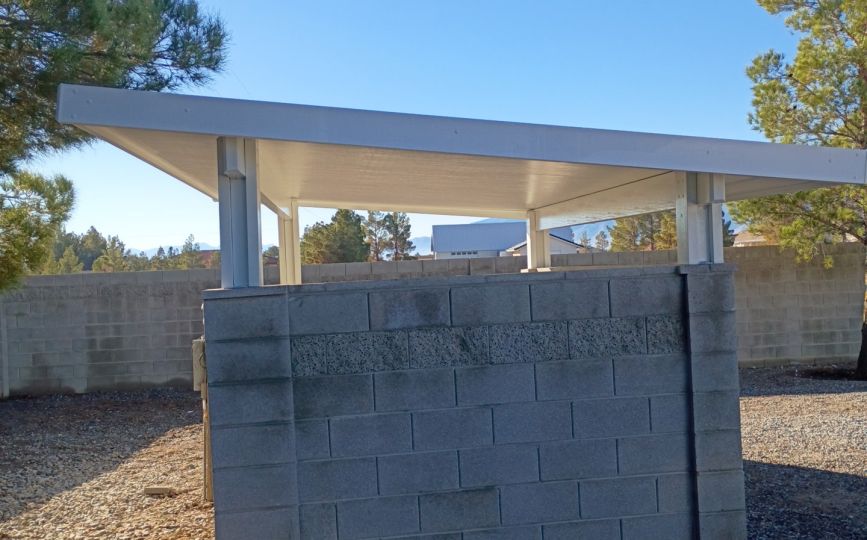
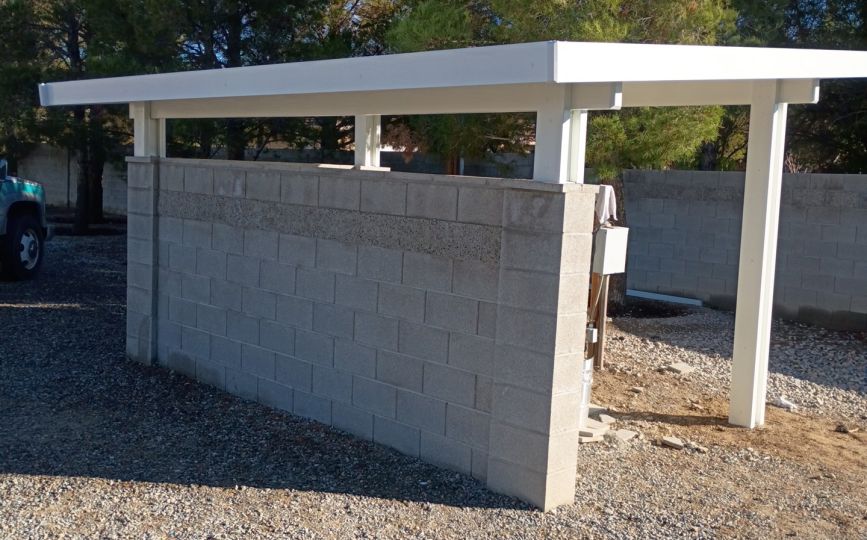
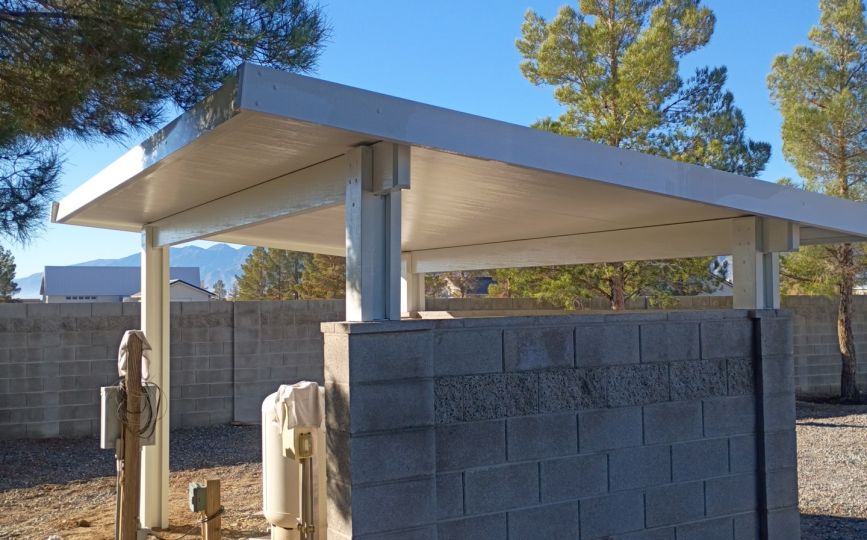
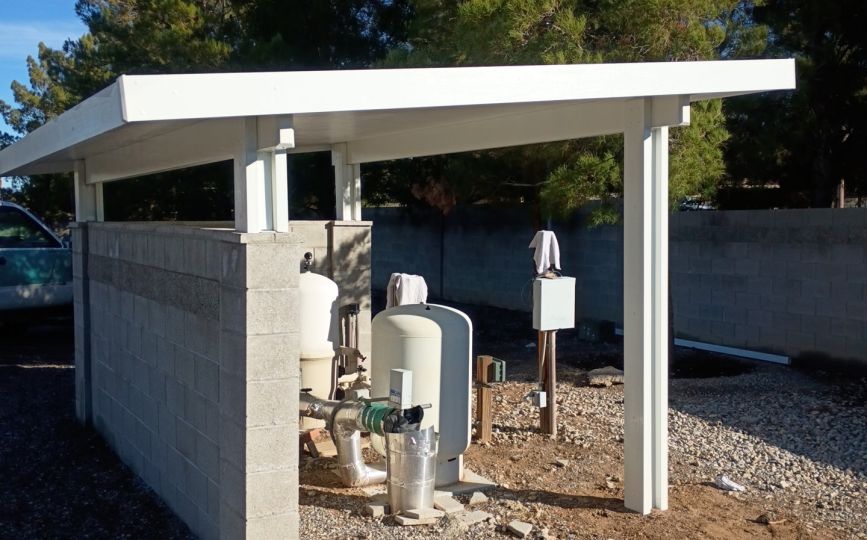

Snowden Designs’ 16′ x 12′ white insulated Alumawood patio cover in Pahrump is built to handle the Mojave heat while keeping your patio way cooler and more comfortable. The reflective “cool roof” finish and 3″ insulated panels block most of the sun’s heat, cut down the warmth that transfers into the house, and can even help reduce AC use. With its 12′ height, steel-reinforced beams, solid wall anchoring, and interlocking Maxx Panels, it’s a strong, low-maintenance setup that stands up to wind, movement in the soil, and all the issues wood patios usually face—like termites and rot. It’s also quieter in the rain, reduces condensation, and feels more like an outdoor room than a metal awning. Plus, it’s energy-efficient, long-lasting, backed by a transferable warranty, and even boosts your home’s value over time.
Backyards in the American Southwest are not just “extra space” anymore; in places like the Pahrump Valley, they are survival zones that have to stand up to brutal sun, high winds, and wild temperature swings. A simple slatted wood shade or thin metal pan roof might look like a patio cover, but it behaves more like a giant outdoor radiator, soaking up solar energy and then blasting that heat back down onto people and into the house. Snowden Designs in Pahrump, NV takes a very different approach, treating a patio cover as a mini engineering project that affects everything from your power bill to your stress level. Their 16′ x 12′ insulated white Alumawood system, mounted 12 feet high on two long-span beams and tied solidly into a brick wall, is a compact example of how modern materials and smart design can completely change how a home performs in the desert. What looks like “just a cover” is actually a carefully tuned piece of thermodynamics, structural engineering, acoustics, and pest control.
To understand why this matters, start with the enemy that rules the Mojave: the sun. In Pahrump, a flat surface can be slammed with roughly a kilowatt of solar energy per square meter during peak summer, which is more than enough to turn metal or concrete into a frying pan. Traditional wood or single-skin aluminum covers happily absorb that energy, convert it to heat, and then radiate it right back down on you and your sliding glass door. Snowden’s 16′ x 12′ cover fights back using two core tricks: color and insulation. The bright white finish is not just a design choice; it’s a physics hack. High-reflectance coatings bounce most of the incoming sunlight away before it can turn into heat, meaning the roof itself runs significantly cooler than darker materials. That “cool roof” effect lowers the starting temperature the insulation has to deal with, acting like the first shield in a layered defense system.
The second shield is hidden inside the panel. Each roof panel is a sandwich: aluminum skin on top, aluminum skin on bottom, and a 3-inch slab of expanded polystyrene (EPS) foam in the middle. EPS is basically 98% trapped air, and still air is terrible at conducting heat. In a plain aluminum roof, heat rockets from the sun-baked top straight through to the bottom, turning the entire underside into a hot plate above your head. In an insulated Alumawood panel, the foam acts as a thermal break, decoupling the hot side from the cool side. Even if the top surface is baking at 160°F, the bottom surface stays close to the shaded air temperature, and the panel’s R-value, around R‑14 for 3 inches, means that heat flow is throttled way down. The result on the ground is not just “shade feels nicer,” but a patio that can be 10–15 degrees cooler than the surrounding unshaded area because the ceiling itself is no longer radiating heat at you.
Height finishes the comfort equation. Most patio covers hover around 8–9 feet, which means the pocket of hot air that builds up under the roof sits right at head level, turning your “oasis” into a toaster oven. Snowden’s design kicks the roof up to 12 feet, which dramatically changes the airflow dynamics. Hot air naturally rises, and with that extra vertical space, it can stratify and collect well above where people are sitting. The living zone from ground to about 6 feet stays filled with denser, cooler air, while the hottest air hangs near the top, where it’s easily swept away by even modest breezes. That extra 3–4 feet might not seem like much on paper, but in daily use it feels like the difference between standing under a broiler and relaxing in the shade.
The benefits don’t stop at the edge of the slab. Because the cover is tied into a brick wall, it also changes how the main house behaves. In full sun, an exposed masonry wall is effectively a rechargeable heat battery: it soaks up energy all afternoon and then bleeds that heat into the interior well into the evening, keeping your AC grinding long after sunset. By projecting 16 feet out, the Alumawood cover throws a huge shadow over the wall, windows, and doors in that zone, cutting direct solar gain at the building envelope. That means the wall never charges up in the first place, reducing the cooling load on the home, shortening AC runtimes, and improving evening comfort inside. What looks like an outdoor upgrade is quietly doing the job of an energy retrofit on the structure it’s attached to.
Of course, the desert doesn’t just bring heat; it brings serious wind. A 16′ x 12′ surface set 12 feet in the air is essentially a big sail, and when high desert gusts race down from the surrounding ranges, they create powerful uplift and lateral forces. As air speeds up over the top of the roof, pressure drops, while the pressure under the cover stays higher, trying to peel the entire structure off the house like the lid off a tin can. Snowden’s system counters that with a monolithic roof design: the Alumawood Maxx Panels snap together with continuous tongue-and-groove joints and are then fastened into a single diaphragm. Instead of a bunch of independent boards flapping in the wind, the entire 192 square feet act as one stiff plate, sharing loads across all connections so no single screw or bracket takes the whole hit. The aluminum alloy itself is chosen to flex without failing, bending slightly under gusts and then returning to shape instead of cracking like brittle materials.
Where the cover meets the house is where engineering really matters. Many desert homes use brick as a veneer, not as structural masonry, which means you can’t just bolt a vibrating, wind-loaded roof into that thin skin and hope for the best. Proper installations drive long anchors or lag screws through the brick and into real structure—rim joists or framing members—often via a continuous ledger board that spreads loads along the entire length. Instead of a couple of heroic bolts doing all the work, you get many fasteners sharing shear and tension forces, so if one hits a void or weak mortar joint, the others back it up. This built-in redundancy is an “invisible” benefit: nobody sees it on a walkthrough, but it is what keeps the cover attached during the once‑in‑decades storm.
Spanning sixteen feet without a center post is another quiet flex. Plain aluminum beams over that distance would sag, especially with live loads from wind or the occasional rare snow, and visible sag would both look bad and stress connections. Alumawood beams often hide steel C-channel reinforcement inside, combining the corrosion resistance and finished look of aluminum with the stiffness and strength of steel. That composite beam lets the design keep a wide-open, post-free view, making the space feel larger and more luxurious, while still meeting structural demands. Functionally, you get a clean, usable area for furniture, grills, or even outdoor kitchens without having to plan around a post planted in the middle of your flow.
Then there’s sound. Anybody who’s sat under a thin metal roof in a desert thunderstorm knows the noise is less “relaxing rain” and more “standing inside a drum solo.” Raindrops hit the rigid sheet, it vibrates like a cymbal, and those vibrations blast the space below with sound, often loud enough that people can’t hear each other talk. The insulated Alumawood panels handle this completely differently. Because the roof is built as metal–foam–metal, the foam layer acts as a shock absorber: when raindrops smack the top skin, much of that vibrational energy gets soaked up and converted into tiny amounts of heat inside the foam instead of pinging through to the bottom. With the skins decoupled by that squishy core, the underside doesn’t mirror the impact. The sound of rain shifts from sharp metallic ringing to a softer, muted thud, closer to what you’d hear under a typical shingle roof. That change turns storms from “patio shut down” into “grab a drink and enjoy the weather.”
Those same panels help with everyday ambient noise too. While an open cover will never block traffic or neighbor sounds the way a solid wall does, a hard, flat metal underside will reflect and bounce noise around, creating a harsh, echoey feel. The textured aluminum skins and foam core of the insulated panels help scatter and dampen reflections, taking some of the harshness out of the acoustic environment. The result is psychological as much as physical: the patio feels more like a calm, semi-interior room than a rattly tin awning, which makes people more likely to use it for reading, conversation, or work.
Living in Pahrump also means living with earthquakes and finicky soil. Heavy wood-and-tile patio covers pack a lot of mass, and in a quake, mass multiplies the forces trying to wrench anchors out of the wall and push posts off their footings. The lightness of Alumawood—with foam-core panels and thin aluminum skins—means much lower inertial forces when the ground shakes, so connections are under less stress and the risk of catastrophic collapse drops. Even in the unlikely event of a failure, lighter components mean less risk of serious injury than falling beams, plywood, and concrete tiles. On the ground, that low weight also puts less pressure on the patio slab, which is a big deal in expansive soils that swell and shrink. The lighter load helps keep slabs from cracking or sinking unevenly under the posts over time.
Biology adds another layer to the story. Despite the dry air, subterranean termites are very much a thing in Nevada, and any wood structure touching or near the ground becomes an attractive target and a bridge toward the house. Wood patio covers demand ongoing vigilance—inspections, treatments, and sooner or later, repairs or partial replacement. Alumawood’s components, by contrast, are metal and plastic foam: no cellulose, nothing for termites, carpenter ants, or wood-boring beetles to eat or nest in. They also shrug off dry rot and fungal decay that chew away at wood in the constant cycle of scorching sun and occasional moisture. Once installed, the structure becomes a biological dead end for pests, removing one more vector of attack on the home.
Desert nights bring one more quirk: condensation. When a single-skin metal roof radiates heat into the clear sky after dark, it can get colder than the surrounding air. If it drops below the dew point, moisture condenses on the underside and drips onto furniture like an invisible, midnight sprinkler system. Insulated panels largely sidestep that issue because the interior skin stays near ambient air temperature instead of plunging toward the cold of deep space. No cold underside, no dew, no weird “indoor rain” soaking cushions and rusting furniture, and less chance of mold or mildew taking hold on the cover itself.
On the finish side, the white Alumawood coating is more than basic paint. High-performance baked-on finishes, often with Teflon-like additives, create a slick, UV-stable surface that resists chalking, fading, and buildup. Dust and bird droppings don’t grip as hard, so the occasional rain or hose-off is often enough to keep things looking fresh without the ritual of sanding, priming, and repainting that wood demands every few years. Aluminum also naturally forms a protective oxide skin that seals it from deeper corrosion, so even scratches don’t turn into structural damage the way rust can on steel.
All of this adds up to a very different financial picture over time. Wood covers may be cheaper up front, but between repainting, pest control, and eventual repair or replacement in 15–20 years, they behave like a subscription expense. An insulated Alumawood cover often runs longer than 50 years with minimal maintenance, trims cooling costs by shading walls and windows, and doesn’t require recurring coatings or treatments. Factor in that modern patio structures routinely rank high for return on investment and buyer appeal, and this kind of installation starts to look less like a splurge and more like a long-term asset. Transferable lifetime-style warranties sweeten the deal, giving future buyers paperwork-backed confidence that they’re inheriting something warrantied, not a ticking repair item.
Finally, there’s the environmental angle. Aluminum is highly recyclable, and recycling it uses a fraction of the energy needed to produce it from raw ore. When the cover eventually reaches the end of its life, those panels and beams become valuable scrap instead of problematic waste, unlike chemically treated lumber that often ends up in landfills. The cool-roof behavior helps cut local heat gain, and the long lifespan means fewer materials cycled through over the decades. In the end, that 16′ x 12′ white insulated Alumawood patio cover from Snowden Designs is much more than shade. It’s a heat shield, wind-tested shell, acoustic blanket, pest barrier, and financial tool, all wrapped into one clean, low-maintenance structure that quietly makes life in the Mojave not just bearable, but genuinely enjoyable.